








本文内容
本文正文为英文版,中文译文正在准备中。
Raft foundations, large pile caps, machine bases and transfer beams and slabs hold large volumes of concrete. They generate a lot of heat of hydration and crack easily if temperature is not controlled. World Steel prepares a separate mass concrete method for each element, combining several measures: crack-control reinforcement, pour division, mix design and concrete temperature, cooling or insulation, and temperature monitoring.
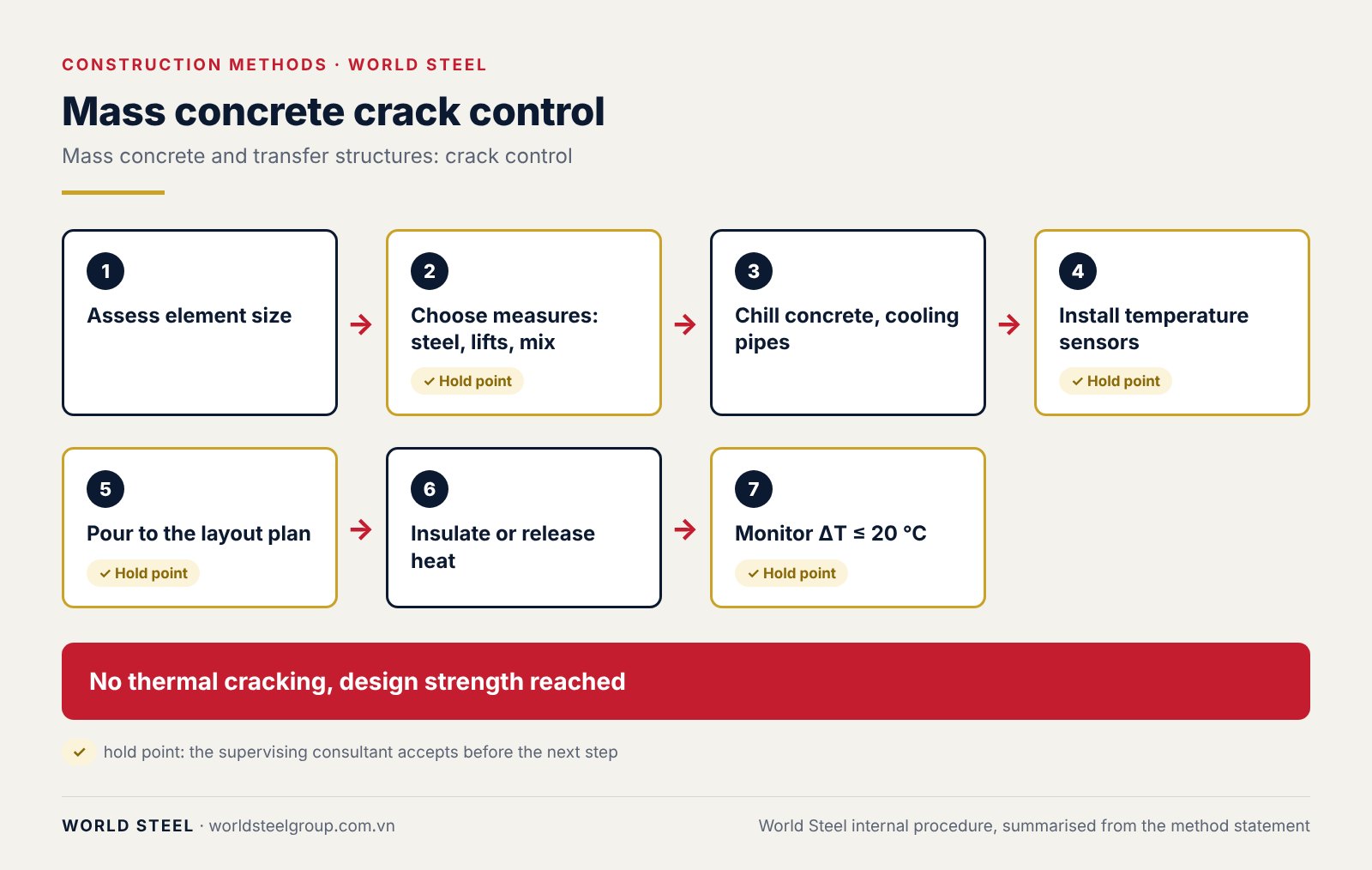
When concrete counts as mass concrete
- Elements whose smallest dimension and height exceed about 2 m must be assessed against mass concrete requirements.
- The main causes of cracking: a temperature difference ΔT between the core and the surface above 20 °C, and a temperature gradient modulus MT above 50 °C/m.
Crack prevention measures
| Measure | Content | Note |
|---|---|---|
| 1. Crack-control steel | Width and height under 1 m: not needed; 1 to 2 m: add a layer of crack-control steel; over 2 m: apply the mass concrete method. Crack-control bars are usually D10–D20 at no more than 300 mm. | Usually combined with other measures. |
| 2. Smaller pours | Divide the height into several lifts, each under 1.5 m. | Easy to build; the construction joint must be treated before the next lift. |
| 3. Mix and admixtures | Medium-aggregate mix with a superplasticiser to cut water content and heat of hydration. | Needs approval by the designer or the supervising consultant; pour at night if possible; the low slump makes congested elements harder to fill. |
| 4. Chilled concrete | Lower the temperature of the fresh concrete (typically to about 28 °C) and measure every truck. | Moderate cost, suits lifts under 3 m high; pour at night if possible. |
| 5. Low-heat cement | Use low-heat cement for foundations with lifts over 2 m high. | Higher cost; longer time to reach design strength (60–90 days). |
| 6. Cooling pipes | Lay D27–D34 steel pipes evenly through the pour and pump cooling water once the concrete starts to heat up (about 15–20 litres per minute). | Cuts hydration heat quickly; high cost; the pipes are grouted afterwards. |
Curing and temperature monitoring
- Heat release (usual case): cover with a moisture-retaining layer (plastic sheet, geotextile) and keep the surface wet.
- Insulation: wrap the pour in 5–10 cm of insulation (foam board, mineral wool or polyurethane) with a rain-proof sheet, to reduce the difference between core and surface temperatures.
- Monitor temperatures with thermometers in water-filled steel tubes, or with sensors installed before the pour. Sensors are placed in sets: one 40–50 cm from the outer face and at least 1 m from the other two; two at the centre of the pour, 1 m apart.
Transfer beams and slabs
| Step | Work |
|---|---|
| 1. Propping | Designed case by case; tower scaffolds, light, medium or heavy frame scaffolding, or steel section props may be used. Use I-beams over voids; back-prop the floors below. |
| 2. Formwork | Calculate formwork deflection and the capacity of clamps and tie rods. |
| 3. Reinforcement | Detailed shop drawings for every bar; accept each layer and each element before fixing the next; only then fix the side formwork. |
| 4. Concreting | Prepare a layout drawing: pump and truck positions, pipelines, pour zones and the person in charge of each. Schedule trucks carefully, keep spare vibrators, and organise shifts for workers and supervisors. |
The aims for transfer structures: the structure below stays safe throughout construction, the pour does not crack from shrinkage or from deflection of the propping, the supplier can deliver the concrete required, and the pour does not drag on.
Reference standards
The edition in force when the contract is signed applies.
- TCVN 9341:2012 Mass concrete – Construction and acceptance
- TCVN 4453:1995 Monolithic concrete and reinforced concrete structures – Code of practice for construction and acceptance


