






Méthode de réalisation des pieux forés
Matériel, contrôle du fluide, forage, mise en place des cages, curage et bétonnage des pieux forés, avec les incidents courants et leurs remèdes.

Dans cet article
Le corps de cet article est publié en anglais ; la traduction française est en préparation.
Bored piles are used when loads are heavy, the bearing layer is deep, or driving and jacking piles would affect neighbouring buildings. Every method follows one of two principles: drilling with a casing, or drilling without a casing (under supporting fluid, or reverse circulation). This article summarises the procedure World Steel applies to bored pile foundations for factories and office blocks.
Equipment and materials
| Equipment, material | Use |
|---|---|
| Reverse circulation rig or bucket drilling rig | Drilling the hole |
| Ultrasonic borehole logger | Measuring hole depth and verticality |
| Grab excavator | Loading spoil onto trucks, breaking the existing slab |
| Air-lift cleaning unit | Removing sediment from the base of the hole |
| Generator, welding sets, bar cutters and benders | Fabricating and welding cages |
| 8"–10" tremie pipes and hopper | Base cleaning and underwater concreting |
| Temporary casing | Stabilising the top of the hole |
| Steel plates and sections | Covering fluid pits and holes, cage support frames |
| Polymer or bentonite powder, soda | Mixing the supporting fluid |
| Crawler crane | Handling casing, cages and heavy equipment |
Work sequence
| Step | Work | Control |
|---|---|---|
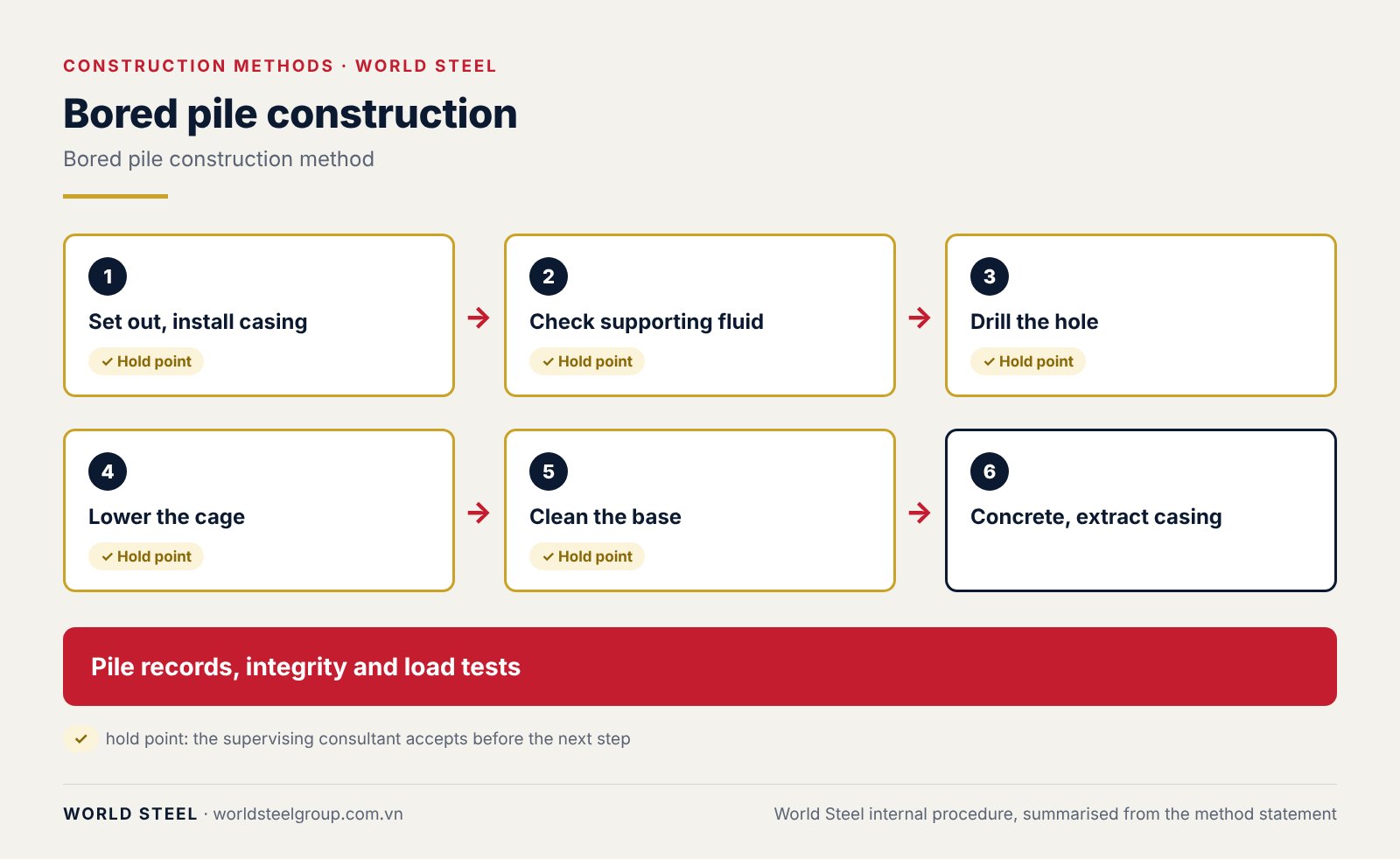
| 1. Setting out, casing | Set out the pile centre; lower the casing with the crane and push it down to existing ground level with an excavator. | Casing coordinates checked with a total station. |
| 2. Fluid check | Test the fluid before drilling and before concreting. | Indicative values for polymer at 21 °C: viscosity 32–50 s (Marsh funnel), pH 8.5–11.5, density 1.0–1.1, sand content below 2%. |
| 3. Drilling | Centre the tool on the casing; level the rotary table; keep the kelly vertical throughout drilling. | Verticality with a spirit level; hole depth and diameter. |
| 4. Cage installation | Lower the cage section by section with the design lap length and link spacing at the splices. For top-down basements, insert the kingpost and weld it to the cage. | Lap length, spacers, cage top level; the kingpost welded to the cage at three evenly spaced points. |
| 5. Base cleaning | Clean the base immediately before concreting. | Base level after cleaning measured with a weighted tape. |
| 6. Concreting, extraction | Pour continuously, logging concrete level against pipe depth; shorten the tremie as it rises; extract the casing after pouring. | The tremie stays at least 3 m inside the concrete to prevent segregation. |
Typical problems and remedies
| Problem | Cause | Remedy |
|---|---|---|
| Hole diameter too small | Drilling too fast, the tool not completing full turns at a level | Redrill where many sections are undersized; where few, add concrete spacers and rotate and raise the cage to scrape the wall |
| Hole collapse | Poor fluid, heavy loads round the hole, drilling too fast | Control the fluid closely; adjust drilling speed to the ground; keep vehicles and heavy loads away from the hole |
| Tremie blocked at the start of the pour | Pipe tip pushed into the soil at the base | Pull the whole tremie, clear it, reinstall and clean the base again before pouring |
| Tremie blocked during the pour | Slump out of range, long wait for concrete | Pull the tremie, redrill, remove the concrete placed and start again; if the concrete has hardened, abandon the pile and replace it as instructed by the designer |
Acceptance
- A record for each pile: coordinates, levels, depth, fluid and hole checks, cage inspection and the concrete pour log.
- Pile integrity and load tests as specified by the designer.
Reference standards
The edition in force when the contract is signed applies.
- TCVN 9395:2012 Bored piles – Construction and acceptance
- TCVN 9393:2012 Piles – Standard test method in situ for piles under axial compressive load