







Noyaux en coffrage grimpant
La séquence de décoffrage, de levage et de réglage du coffrage grimpant des noyaux d’ascenseurs et d’escaliers, avec les points clés sur les ancrages et la sécurité.

Dans cet article
Le corps de cet article est publié en anglais ; la traduction française est en préparation.
World Steel builds the lift and stair core walls of multi-storey office blocks with climbing formwork, which rises with each pour and is anchored into the concrete of the previous lift. The system gives an even wall finish, a steady floor-by-floor cycle and safe working platforms on both the inside and the outside of the core.
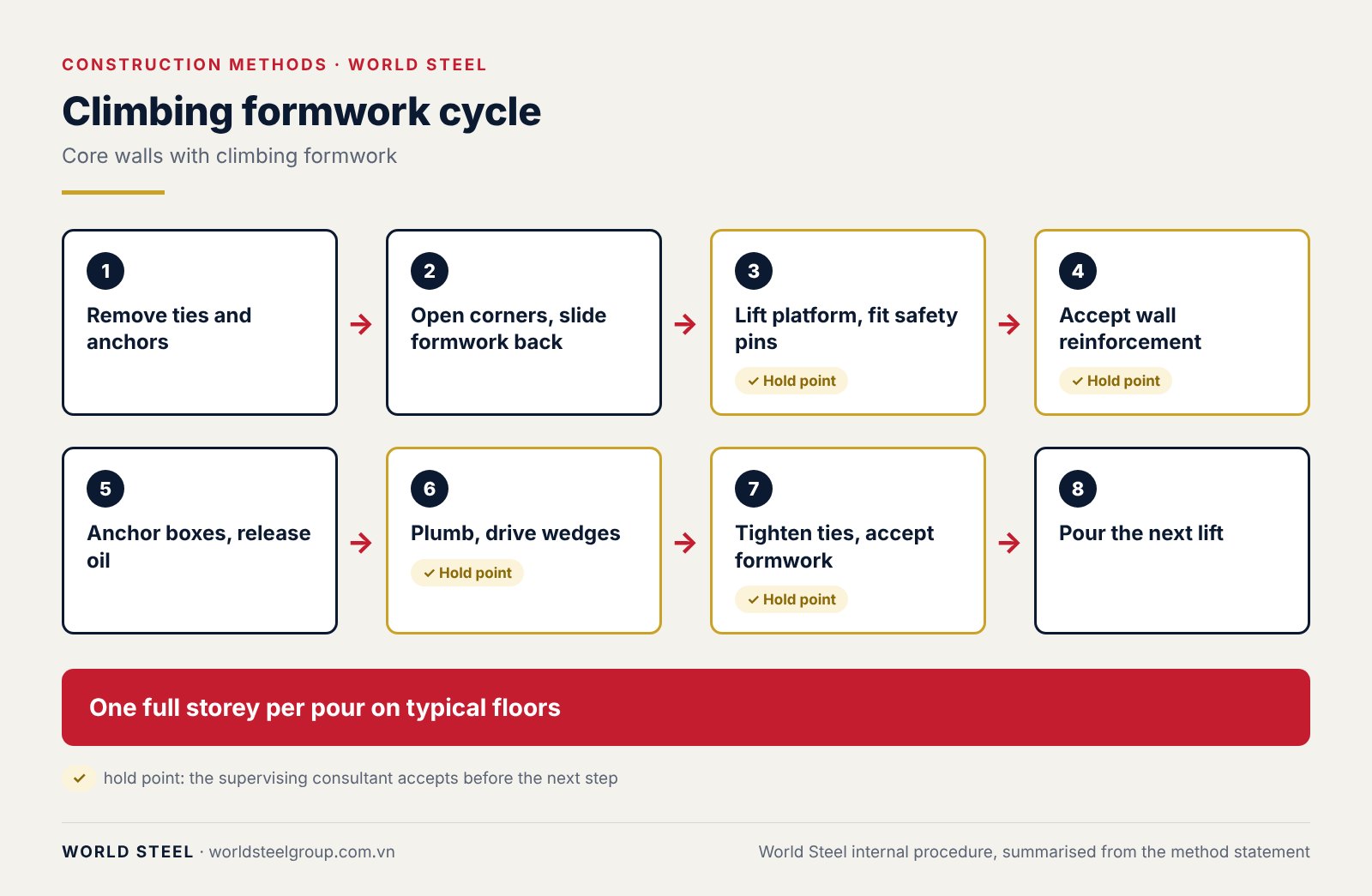
Striking and climbing sequence
| Step | Work |
|---|---|
| 1–3 | Remove the edge ties, corner ties and anchor bolts of the previous lift. |
| 4–6 | Remove the anti-slip and corner-locking wedges; turn the struts to open the formwork corners; turn the gear to slide the formwork away from the wall. |
| 7–9 | Strike the inner formwork, remove the anchor boxes used for the inner platform, and remove the wind bracing. |
| 10–12 | Remove the safety pins at the anchors before lifting; lift the platform off the old anchors; set it on the new anchors and fit the safety pins before releasing the crane slings. |
| 13 | Refit the wind bracing. |
Setting the formwork for the next pour
| Step | Work |
|---|---|
| 14 | Accept the wall reinforcement already fixed. |
| 15–17 | Position and grease the anchor boxes on the formwork; apply release oil to the panel faces; position the anchor bolts. |
| 18–19 | Check survey levels and formwork verticality. |
| 20–21 | Adjust the jacks; tighten the formwork foot ties once in position (check that the stops are inside the formwork before tightening). |
| 22–25 | Move the formwork against the wall; adjust the corner opening; drive home the corner and travel wedges. |
| 26–27 | Tighten the corner and edge ties, and accept the formwork before concreting. |
Points to watch
- Choose the anchor positions for the first pour so that, on typical floors, each pour covers exactly one storey, floor to floor.
- Keep anchor bolts clear of doors and openings, especially in the last pours of the typical floors; provide the full number of anchors as designed.
- Release the wedges before moving the frame and opening the corners, and avoid excessive force that can damage the connections.
- Grease the anchor boxes and seal the threaded plugs before the pour so they can be removed easily.
- After lifting to the new position, fit the safety pins and the wind bracing before releasing the crane slings.
- Close all gaps in the working platforms to protect people below; provide guardrails; inspect and maintain the access ladders regularly.
Common mistakes
| Mistake | Consequence | Prevention |
|---|---|---|
| Anchor bolts at doors or openings | Next lift cannot be anchored | Check the architectural drawings when setting anchors |
| Anchor boxes not greased or plugs not sealed | Anchor boxes cannot be removed | Include in the formwork acceptance record |
| Crane slings released before safety pins are fitted | Risk of the platform falling | A defined lifting sequence with a supervisor present |
| Gaps in the working platform | Objects falling to the area below | Inspect before every climb |
Reference standards
The edition in force when the contract is signed applies.
- TCVN 4453:1995 Monolithic concrete and reinforced concrete structures – Code of practice for construction and acceptance
- TCVN 5308:1991 Code of practice for safety in construction


