







この記事の内容
この記事の本文は英語版を掲載しています。日本語訳は準備中です。
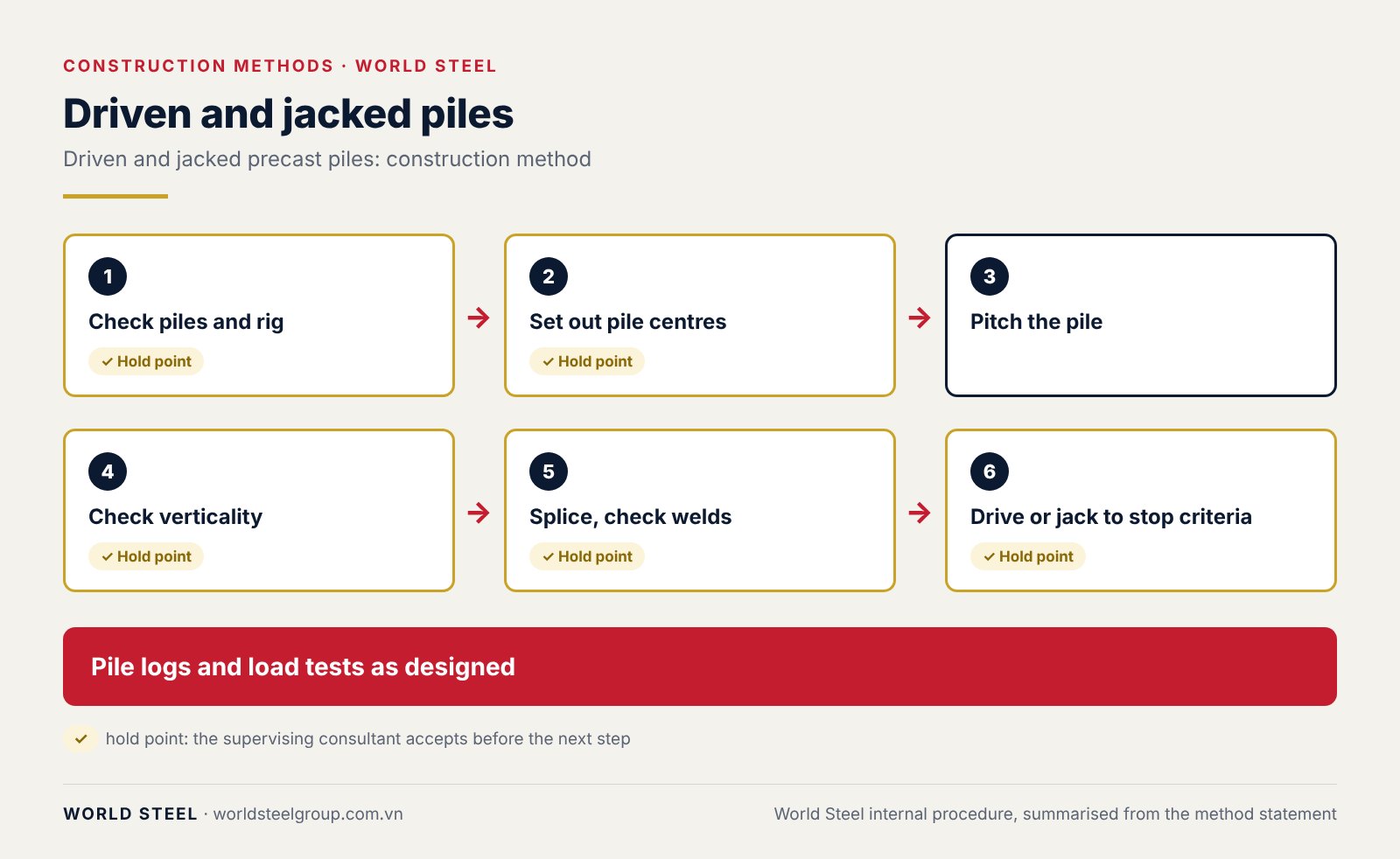
Precast concrete piles installed by driving or by jacking are the most common foundation for factories in industrial parks. Both methods share the same preparation, pile checks, setting out and acceptance; they differ in the installation rig and in the criteria for stopping.
Preparation
- Method drawing: rig travel plan, piling sequence, pile storage area.
- Equipment: piling rig and hammer or jacking rig, crane for pile handling, welding sets and consumables. Every machine on site must have a valid inspection certificate.
- Checks on delivered piles: cracks, pile records and factory acceptance certificates; splice plates or splice boxes checked for dimensions and steel grade. Reject piles that do not comply.
- Mark length graduations on each pile; for driven piles, also mark the hammer drop height.
Driving sequence
| Step | Work | Control |
|---|---|---|
| 1. Setting out | Set out grid lines with a total station and levels with a level. | Pile centre coordinates before pitching. |
| 2. Pitching | Lift the pile into the leaders and place the helmet correctly. | Lifting and support points as per the pile design. |
| 3. Verticality | Check in two directions with a theodolite or plumb line, repeatedly during driving. | Stop and correct a leaning pile. |
| 4. Splicing | Splice with plates or splice boxes; weld as designed; coat with bitumen after welding. | Weld quality. |
| 5. Driving | Record blows per depth, hammer drop and penetration. | Driving log. |
| 6. Set | When the pile starts to refuse, stop to measure the set; record over the last 10 blows. | Set compared with the design value. |
Jacked piles: choosing the rig and stopping criteria
- Small jacking frame with kentledge: for tight sites, few piles and low jacking loads.
- Self-propelled hydraulic jacking rig: for wide, level sites with firm ground; many piles, high loads, fast progress.
- The rig and kentledge are usually sized with an overload factor of 1.3–1.5. Typical jacking loads: Pmax = (2–3) Pdesign, Pmin = (1.5–2) Pdesign, or as specified by the designer.
- Record the jacking force (hydraulic gauge reading) against the depth marks on the pile. Stop when the force reaches Pmax and the depth reaches Lmin as designed.
Load testing
- High-strain dynamic testing (PDA): gauges are fixed to the pile, which is struck and the wave signals analysed to assess capacity.
- Static load test: load applied in stages to test piles according to the approved test plan.
Cracked or broken piles and prevention
| Stage | Checks that prevent damage |
|---|---|
| Transport, lifting | Concrete age of the pile; lifting technique; support positions. |
| Driving or jacking | Pile concrete strength; hammer suited to the design load (an unsuitable hammer breaks the pile head); soil report when false refusal or a hard lens is met; verticality and eccentricity when pitching; splice welds; a set criterion that suits the ground. |
Reference standards
The edition in force when the contract is signed applies.
- TCVN 9394:2012 Driven and jacked piles – Construction and acceptance
- TCVN 9393:2012 Piles – Standard test method in situ for piles under axial compressive load