







Site preparation & infrastructure
Internal roads, drainage and kerbs: infrastructure works method
The sequence for subgrade, granular base, concrete pavement, drainage pipes and kerbs inside the factory boundary, with the main acceptance points.

In this article
Infrastructure inside the factory boundary covers internal roads, parking, storm drainage, kerbs and footpaths. It is usually built in parallel with the factory finishes and must carry container trucks as soon as the plant opens, so World Steel controls every step from setting out and stripping topsoil to compaction and asphalt paving.
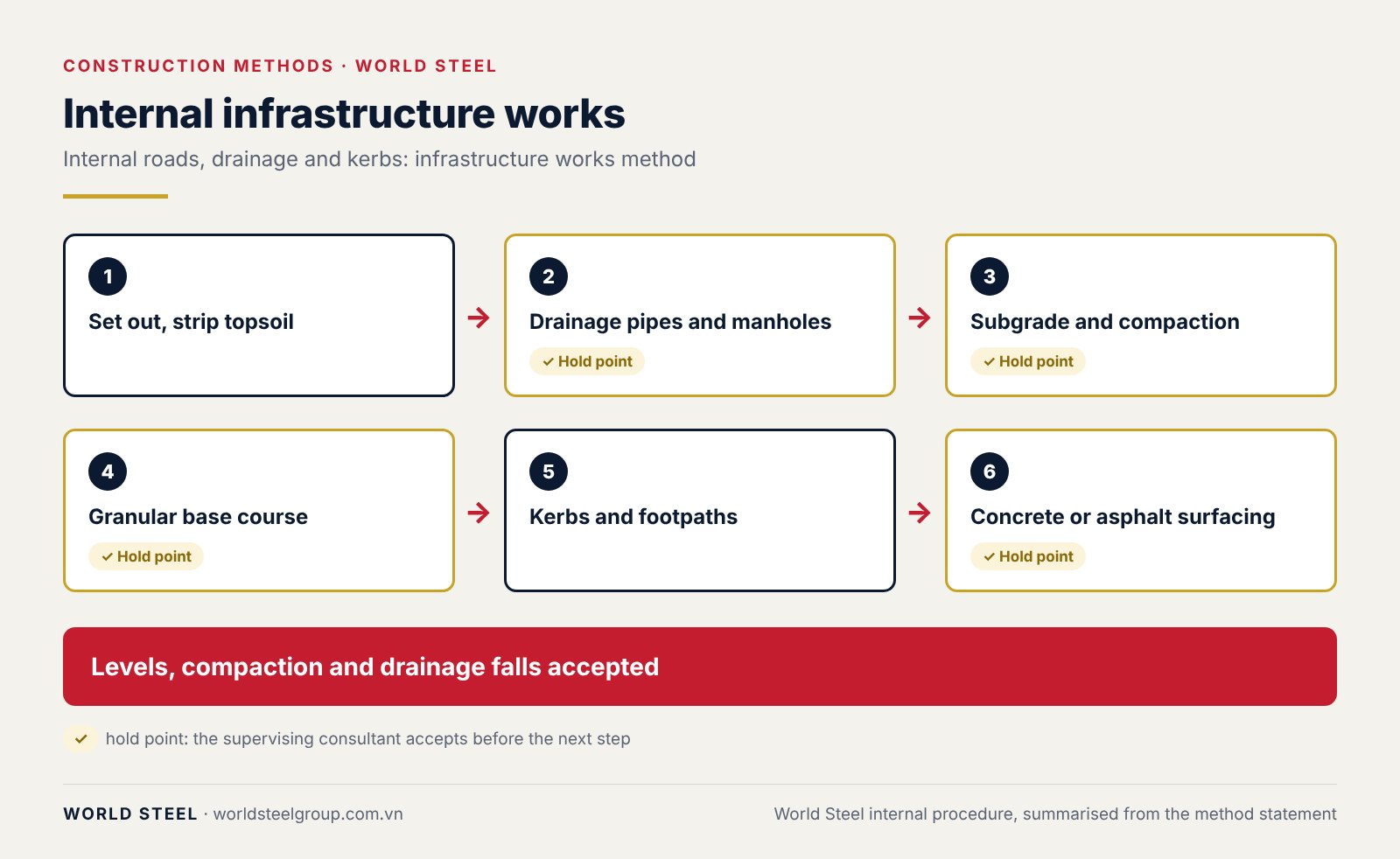
Work sequence
| Step | Work | Control |
|---|---|---|
| 1. Setting out, stripping | Stake the road centreline; strip all topsoil, vegetation and any pockets of mud. | Check the centreline with a total station; inspect the excavation before filling. |
| 2. Drainage | Excavate pipe trenches and manholes to design level; place pipe bedding blocks; lay the pipes and seal the joints with mortar; backfill with sand and compact. | Level and position of each bedding block and the pipe gradient; tight joints. |
| 3. Subgrade | Cut or fill to design level and compact to the design density. | Density (K) test before moving on. |
| 4. Crushed stone base | Source and grading approved by the supervision consultant; watered and rolled layer by layer, about 200 mm per layer. | Density (K) and elastic modulus (E) tests of the base. |
| 5. Kerbs, footpaths | Set out kerbs to position and level; fix steel kerb forms, cast and finish the concrete; cure. Compact the footpath subgrade and lay paving. | Line, level and surface flatness of the kerbs. |
| 6. Asphalt | Spray the emulsion coat; lay the coarse asphalt course, then the fine wearing course. | Asphalt temperature on arrival; elastic modulus after paving; road crossfall. |
Points to watch for the base and asphalt
- The crushed stone grading must meet the specification, otherwise the base will not reach the design density.
- Pave only on a dry, clean base and in dry weather, otherwise the asphalt will peel later.
- Cover finished kerbs before spraying the emulsion.
- The road crossfall must match the design so water does not pond.
Common mistakes
| Mistake | Consequence | Prevention |
|---|---|---|
| Centreline set out wrongly | Road off its design alignment | Set out with a total station and check the stakes before excavating |
| Topsoil or mud pockets not fully removed | Subgrade fails to reach density and settles later | Inspect the formation with the supervision consultant |
| Wrong pipe levels or gradient | Poor drainage, local flooding | Check the level of every bedding block |
| Pipe joints poorly sealed | Leaks that wash out the ground | Inspect joints before backfilling |
| Sand backfill not compacted | Settlement in heavy rain or in service | Compact in layers and test density |
Reference standards
The edition in force when the contract is signed applies.
- TCVN 4447:2012 Earth works – Construction and acceptance
- TCVN 8859:2011 Graded aggregate base and subbase for road pavements – Materials, construction and acceptance
- TCVN 8819:2011 Hot mix asphalt pavements – Construction and acceptance

